

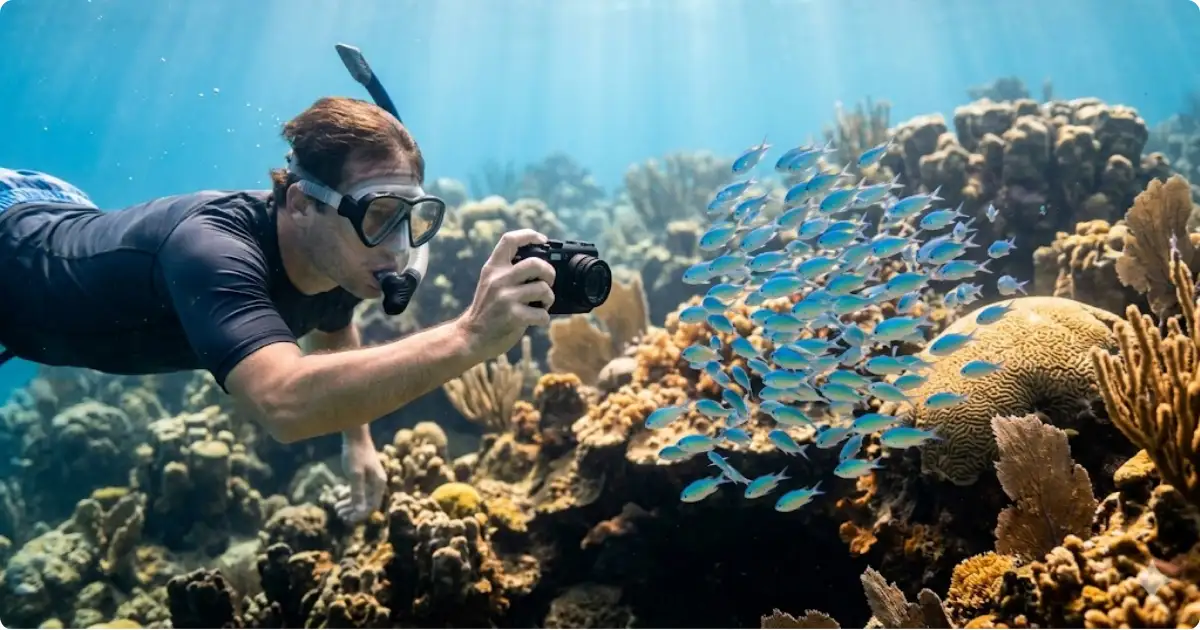
Most snorkelers pick a camera based on brand recognition then spend their entire reef trip wondering why every photo looks like a blue fog bank.
The problem is rarely the camera itself. It’s buying the wrong type for your skill level, travel style, and budget. A GoPro is not automatically the right answer. Neither is the most expensive option on the shelf.
This guide covers five camera types tested across real snorkeling conditions. We match each one to the right snorkeler so you arrive at the reef with the correct tool, not someone else’s recommendation.
SHORT ANSWER:
The OM System TG-7 is the strongest all-round underwater camera for snorkeling no separate housing needed, 4K video, exceptional macro stills. For video priority, choose the DJI Osmo Action 6. Under $100, an IP68 phone pouch paired with your existing smartphone outperforms any cheap compact camera.
Which Camera Fits Your Snorkeling Style?
| Snorkeler Type | Best Camera Type | Top Pick | Budget Range | Key Trade-off |
|---|---|---|---|---|
| First-timer / Casual | Phone pouch | IP68 double-pouch | $25–$50 | Limited sharpness vs dedicated cameras |
| Holiday traveler | Waterproof compact | OM System TG-7 | $350–$450 | Lower video ceiling than action cameras |
| Smartphone owner | Smartphone housing | ProShot Case / DIVEVOLK | $60–$180 | Depth-limited vs purpose-built cameras |
| Video-focused | Action camera | DJI Osmo Action 6 | $200–$350 | Weaker stills vs waterproof compacts |
| GoPro ecosystem owner | Action camera | GoPro Hero 13 | $350–$450 | Color needs filter — not automatic |
| Creative / storyteller | 360-degree camera | Insta360 X5 | $500+ | Heavy editing time required post-trip |
The right underwater camera depends entirely on what kind of snorkeler you are. Different cameras solve fundamentally different problems.
- Casual snorkeler: Use your phone in a waterproof housing. Fast, affordable, good enough.
- Holiday traveler: Pick the OM System TG-7. No external housing needed. Packs small.
- Video-focused: Choose the DJI Osmo Action 6 for superior color and low light.
- Creative storyteller: Insta360 X5 captures everything without manual aiming.
- Budget buyer: Under $100, a quality phone pouch outperforms cheap compact cameras.
- GoPro ecosystem owner: Hero 13 with a filter kit delivers excellent results.
Knowing your style before buying saves money and prevents reef-day regret.
The 5 Camera Categories What Each Does Best
Every underwater camera for snorkeling falls into one of five types. Each solves a different problem.
Waterproof Compact Cameras
These cameras are already sealed against water. No external housing required.
- Choose when: You want excellent photos with zero setup complexity.
- Skip when: Deep waterproofing or maximum video resolution is essential.
- Best pick: OM System TG-7 leads this category clearly.
- Key strength: Exceptional macro capability unmatched on coral reef close-ups.
- Weak point: More flood-risk than a camera sealed inside a rigid housing.
Waterproof compacts suit the widest range of snorkelers at a fair price.
Action Cameras
Action cameras are purpose-built for video and are compact enough for any carry-on.
- Choose when: Video quality is your top priority.
- Skip when: You shoot mainly stills and want close-up macro detail.
- Best for color: DJI Osmo Action 6 dedicated white balance sensor sets it apart.
- Best for ecosystem: GoPro Hero 13 accessories available at most dive shops globally.
- Essential add-on: A color correction filter. Without one, footage looks washed blue.
A floating grip handle is non-negotiable with any action camera. It sinks otherwise.
360-Degree Cameras
360° cameras record every direction simultaneously. You choose the frame in editing.
- Choose when: You want immersive storytelling video, not snapshots.
- Skip when: You shoot mainly stills or dislike post-production editing.
- Best pick: Insta360 X5 with the Invisible Dive Case Pro.
- Key advantage: Watch the reef the camera handles everything else.
- Key drawback: Editing requires significant time and computing power.
These are creative tools, not simple point-and-shoot cameras.
Smartphone Housings
You already own an excellent camera. The right housing unlocks it underwater.
- Choose when: You want the simplest setup using gear you already own.
- Skip when: You need to dive beyond shallow snorkeling depths.
- Best affordable pick: ProShot Case for iPhones and Android.
- Best full-touch pick: DIVEVOLK SeaTouch 4 Max.
- Key benefit: No new system to learn use apps already on your phone.
Smartphone housings are the fastest and most affordable entry into underwater photography.
Budget Phone Pouches
Waterproof phone pouches are the most accessible underwater camera option available.
- Choose when: Budget is tight and photos are casual.
- Skip when: You want sharp, detailed images of reef life.
- Look for: IP68-rated double-pouch designs with a clear optical window.
- Key limit: Touch screens lose some sensitivity in water plan accordingly.
- Best use case: Shore snorkeling where losing the camera is a real risk.
Phone pouches are the right starting point for first-timers not yet ready to invest.
Best Waterproof Compact: OM System TG-7
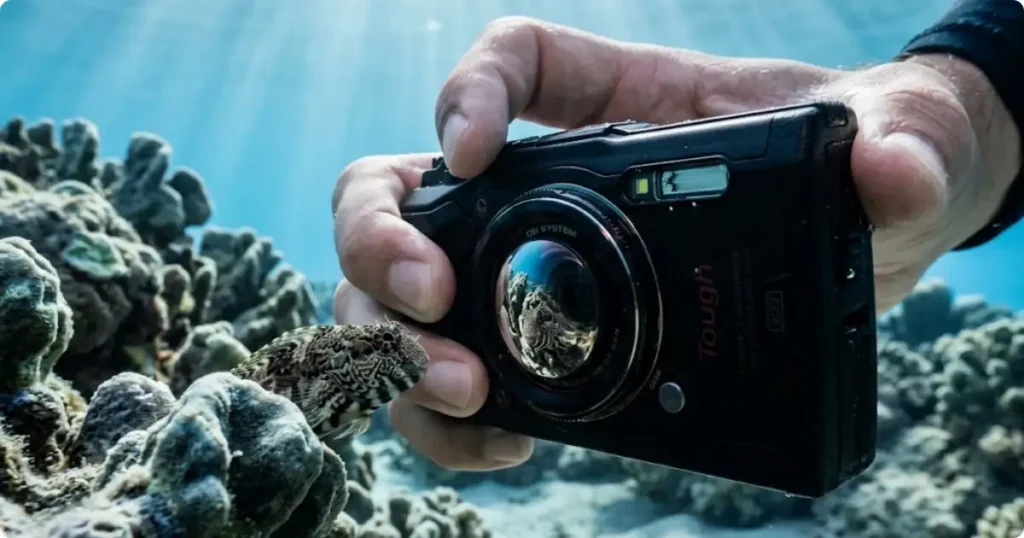
The OM System TG-7 is our top waterproof compact for snorkeling in 2026. It carries forward the beloved Olympus TG series with meaningful refinements.
- Shoot it for: Reef macro shots, shallow water, and all-round versatility.
- Skip it for: Dedicated video work or deeper waterproofing requirements.
- Sensor: 12-megapixel with excellent color performance underwater.
- Video: 4K capable sufficient for sharing and quality editing.
- Lens: Fast f/2.0 aperture, 25–100mm zoom a strong range for fish and reef.
It also includes dual image stabilization, a built-in compass, and a depth gauge. These are genuinely useful tools in the water, not marketing specs.
What Makes It the Top Pick
The TG-7’s macro mode is exceptional. It focuses closer than almost any other camera in this class. Combined with the fast f/2.0 lens, it stops fast-moving fish cleanly. Underwater white balance settings for multiple depth ranges are properly implemented producing natural color without a separate filter.
Who Should Buy It
Holiday travelers, reef photographers, and anyone who values simplicity should buy the TG-7. One key tip: pair it with the OM System PT-059 housing for added durability and access to wide-angle lens attachments. Pack it alongside your snorkel sets for a complete underwater photography kit.
Best Action Camera: DJI Osmo Action 6 vs GoPro Hero 13
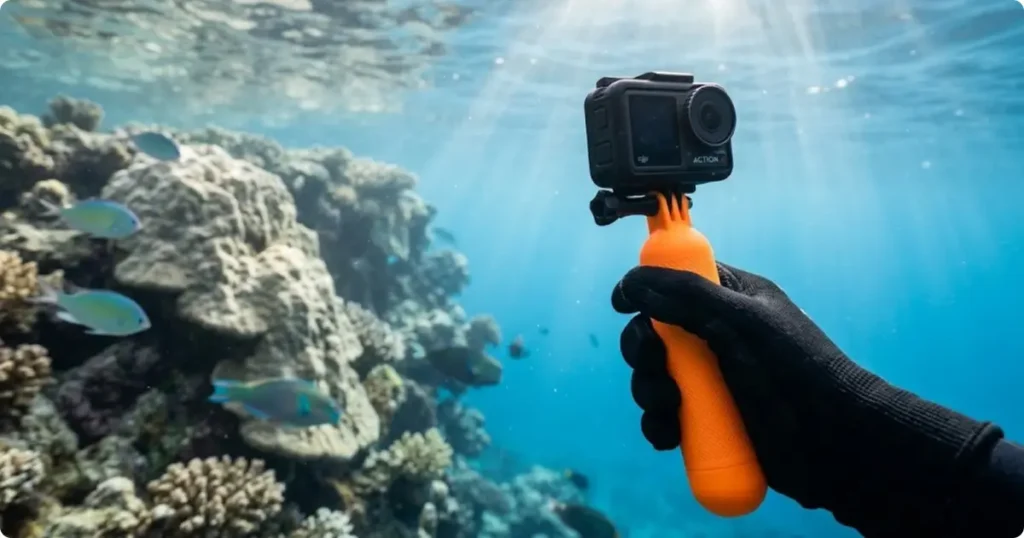
Action cameras dominate the snorkeling camera market in 2026. Two models lead the field decisively.
- DJI Osmo Action 6 wins on: Color accuracy, low light, battery charge speed.
- GoPro Hero 13 wins on: Accessory ecosystem, brand availability, field familiarity.
- Both require: A floating grip handle non-negotiable in open water.
- Both require: A color correction filter kit for vivid underwater results.
- Budget: Both sit in a comparable price range for their base configurations.
Choosing between them comes down to one question: what matters more color or convenience?
DJI Osmo Action 6 Better for Snorkeling Colors
The DJI Osmo Action 6 has a larger image sensor than competing action cameras. This delivers cleaner results in high-contrast underwater conditions. Its dedicated built-in white balance sensor reads color at each depth automatically. Batteries also charge significantly faster than previous action camera generations.
The menu system is cleaner and easier to operate than GoPro’s. Screens are larger and readable in direct tropical sunlight. Built-in memory backs up footage if a card fails a useful feature when you’re far from shore.
One known issue: the automatic white balance occasionally produces unusual color shifts at certain depth transitions. Our testing found this happens inconsistently. However, overall color results remain superior to GoPro in typical snorkeling conditions.
GoPro Hero 13 Still Excellent for Travel
The GoPro Hero 13 is waterproof to 33 feet without any additional housing. Its accessory ecosystem is the most extensive in the action camera market. Filters, mounts, floating grips, and compatible housings are sold at dive shops worldwide including remote destinations.
The frame grab feature is particularly valuable for snorkelers. You record continuously and pull sharp still frames during editing. No missed moments from trying to time a shutter button underwater. Vertical 9:16 capture mode produces social-ready footage without quality loss from cropping.
INSIDER SECRET: GoPro color filter kits are not cross-compatible between camera generations. If you upgrade to the Hero 13, verify your existing filter kit explicitly states Hero 13 compatibility before your trip. Many snorkelers discover this incompatibility while already at the reef with no replacement available.
Action Camera Verdict
For most snorkelers prioritizing underwater color and image quality, the DJI Osmo Action 6 is the stronger pick. For those already invested in the GoPro ecosystem with existing filters, mounts, and accessories the Hero 13 remains fully capable.
Best 360-Degree Camera: Insta360 X5
The Insta360 X5 takes a fundamentally different approach to snorkeling photography. It records everything simultaneously you choose the frame in post-production.
- Ideal for: Travel video creators who want immersive, cinematic content.
- Not for: Still photographers or anyone without post-production time.
- Key accessory: Insta360 Invisible Dive Case Pro purpose-built for snorkeling.
- Add-on: Dive Buddy floating handle holds the camera at any set depth.
- Editing requirement: Significant computing power and editing time required.
This is a creative storytelling system not a quick-snap snorkeling camera.
The Storytelling Advantage
The Insta360 X5 captures every direction at once. You watch the reef the camera handles framing automatically. The Dive Buddy accessory allows the camera to hover at a set depth. This produces smooth, stable underwater footage that no handheld action camera can replicate.
The X5 works equally well above the surface. The same system that films reef life also documents the boat, the coastline, and topside moments without switching gear.
Know the Drawbacks First
360-degree cameras struggle with close-focus distances. Macro shots of reef detail are not their strength. Editing 360-degree footage takes significantly more time than standard video. Files are large, processing is slow, and results depend on editing skill. For snorkelers willing to invest the post-production time, the creative results are genuinely impressive.
Best Smartphone Housings for Snorkeling
Your smartphone camera is already excellent. The right housing makes it fully functional underwater.
- Check fit before buying: Housings are model-specific confirm compatibility.
- Avoid soft pouches: They distort through the lens port and reduce sharpness.
- Always use a lanyard: Phones are negatively buoyant they sink immediately.
- Test the seal first: Submerge in a bathtub with a tissue inside before the reef.
- Upgrading phones: Simply buy a new housing the system scales with you.
Smartphone housings remove the need to learn an entirely new camera system.
ProShot Case Best Affordable Option
ProShot makes purpose-built sealed housings for iPhone and Android devices. These are rigid waterproof cases not pouches. The companion app optimizes the phone’s camera settings for underwater conditions. Pricing for most configurations falls well under $100. They are rated for typical snorkeling depths and have proven durability across real ocean use.
DIVEVOLK SeaTouch 4 Max Best Full-Touch Option
The DIVEVOLK SeaTouch 4 Max uses a membrane system that allows full touch-screen control underwater. No companion app required. No Bluetooth connection draining your battery during a session. Compatible with most iPhones, Samsung Galaxy, and Google Pixel models. The fully sealed buttonless design also produces an exceptionally waterproof seal.
Best Underwater Camera for Snorkeling Under $100
Under $100, options narrow sharply but one approach outperforms everything else in this bracket.
- Best pick: IP68-rated waterproof phone pouch paired with your existing smartphone.
- Avoid: Cheap no-brand compact cameras image quality is consistently poor.
- Look for: Double-pouch designs one for the phone, one for keys and cards.
- Add: A short floating wrist lanyard always.
- Reality check: Budget compacts under $60 produce blurry, color-dead images.
Your current smartphone in a $25–40 IP68 pouch delivers far better results than a $60 generic compact camera. Use your best existing technology rather than buying inferior dedicated hardware. Round out your kit with solid dry bags for safe transport between locations.
Why Your Underwater Photos Look Blue And How to Fix It
Water absorbs light wavelengths at different depths. Red disappears within a few feet of the surface. Orange and yellow follow at greater depth.
- Use a red filter: Restores natural color in clear, blue open-ocean water.
- Use a magenta filter: Better suited for green-tinted bay and tropical shelf water.
- Use a snorkel-specific filter: Optimized for very shallow reef environments.
- Match filter to water color: Wrong filter makes color problems worse, not better.
- Check model compatibility: Filters are not universal verify before purchase.
Most underwater photos look blue because snorkelers skip the filter entirely. The right filter is the single highest-impact upgrade most snorkelers can make at minimal cost.
5 Things to Check Before You Buy
Five factors determine whether a snorkeling camera works in real ocean conditions. Check every one before purchasing.
- Waterproof depth rating: Most snorkelers need at least 10 meters (33 feet).
- Filter compatibility: Confirm filter kits exist specifically for your chosen model.
- Floating grip availability: Action and 360-degree cameras need one always.
- Video vs stills priority: Action cameras lead on video. Compacts lead on stills.
- Pack size: Bulky housings complicate carry-on travel check dimensions before packing.
Skipping any one of these creates a problem at the reef where no fix is available. Review your camera alongside the rest of your trip gear it is one piece of a complete kit.
Final Take
After testing five camera types in real snorkeling conditions, the OM System TG-7 is the top pick for most buyers. It’s compact, genuinely waterproof, and produces sharp macro stills that action cameras cannot match. Video-focused snorkelers should prioritize the DJI Osmo Action 6 its color accuracy underwater is demonstrably ahead of the competition in 2026. Beginners and budget buyers: start with your smartphone and a quality housing. Add a color correction filter as a second step.
