
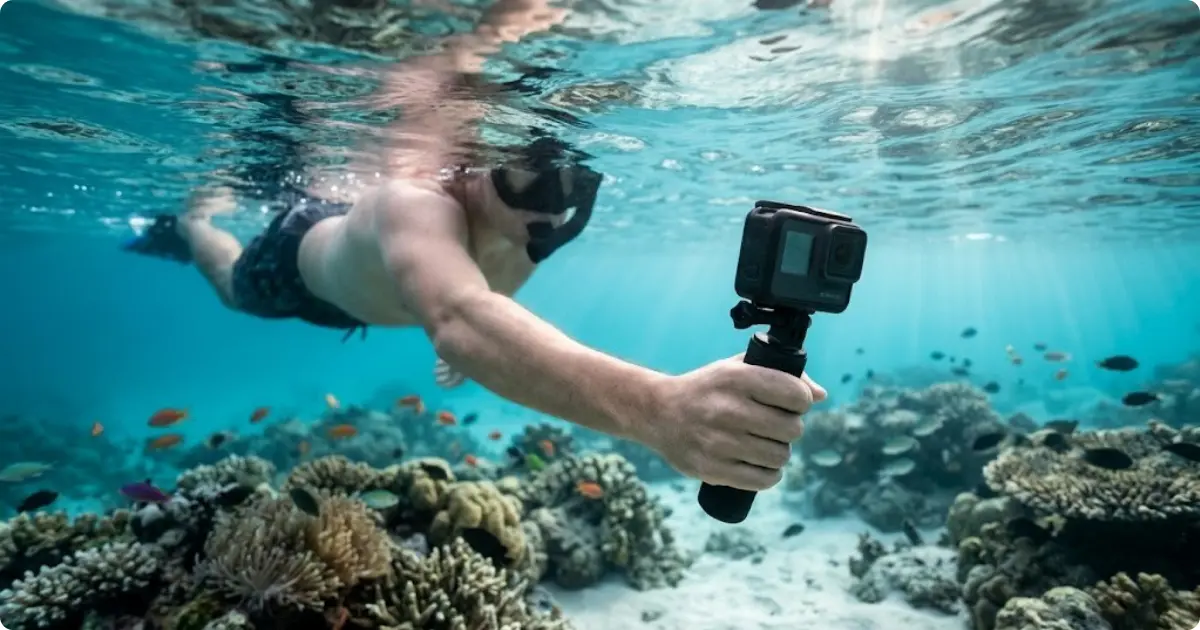

We packed six underwater cameras into the same gear bag. Then we took them snorkeling across three different locations.
Most underwater camera reviews test one camera at a time. That makes honest comparison nearly impossible. Different lighting, different water clarity, and different days mean you never see true side-by-side results.
This article shows exactly what each camera captured in identical conditions. No sponsored picks. No spec-sheet padding. Just real snorkeling footage compared frame by frame.
QUICK ANSWER: The GoPro HERO13 Black delivers the best all-around results for snorkeling. However, the DJI Osmo Action 5 surprised us with deeper waterproofing and better auto color correction. For still photos, the OM System TG-7 outperformed every action camera we tested. Your best pick depends on whether you prioritize video, stills, or budget.
How We Ran This Test
We designed this test to answer one question. Which camera actually performs best in real snorkeling conditions?
- Pick six cameras spanning four price brackets
- Use all six on the same reef during the same session
- Shoot identical scenes for direct comparison
- Test in shallow reef, open water, and low-visibility conditions
- Record battery drain from full charge to shutdown
Every camera ran factory default settings first. Then we optimized each using its best underwater mode. We compared both results.
We tested across three trip conditions. A clear tropical reef with 20-meter visibility came first. Next, a shallow rocky coastline with moderate surge. Finally, a murky harbor reef with less than 5 meters of visibility.
That last location mattered most. Any camera looks decent in crystal-clear water. The real test is what happens when conditions go bad.
Camera-by-Camera Breakdown
Here’s what each camera delivered across all three sessions. We scored video quality, still photo sharpness, color accuracy, and ease of underwater use.
GoPro HERO13 Black
The HERO13 remains the default choice for most snorkelers. Its HyperSmooth 6.0 stabilization produced the steadiest footage of any camera we tested.
- Shoot 5.3K video at 60fps for buttery-smooth clips
- Use the 177-degree wide-angle to capture full reef scenes
- Check depth limits — waterproof to only 33 feet without housing
- Skip the touchscreen underwater — it misfires constantly when wet
Video quality impressed us in clear water. Colors leaned slightly blue in deeper sections. However, the massive GoPro accessory ecosystem makes it incredibly versatile.
Still photos were acceptable but never outstanding. Action cameras prioritize video, and that trade-off shows in single-frame sharpness.
DJI Osmo Action 5
This camera delivered the biggest surprise of the entire test. Its 66-foot depth rating without a housing doubles what GoPro offers.
- Pick this for worry-free depth — 66 feet with no case required
- Use the built-in color temperature sensor for auto white balance
- Check the 48GB internal storage as backup if you forget a card
- Avoid trusting the underwater color grading fully — it oversaturates
RockSteady 3.0 stabilization came close to GoPro’s HyperSmooth. However, the auto color correction was a clear advantage. The DJI consistently produced warmer, more natural tones without any post-editing.
Resolution caps at 4K. That’s a step below the GoPro’s 5.3K ceiling. For social media and standard sharing, most snorkelers will never notice the difference.
OM System TG-7
If still photography matters more than video, the TG-7 wins outright. No action camera we tested matched its photo quality.
- Pick this for sharp reef stills and macro shots of small marine life
- Use the microscope mode for incredible close-up detail
- Check the 4x optical zoom to capture shy fish from a distance
- Skip this if video is your primary goal — 4K performance is modest
The TG-7 is waterproof to 50 feet without a housing. Additionally, it’s shockproof, crushproof, and freezeproof. We dropped it on volcanic rock between sessions. Zero damage.
Built-in GPS, compass, and depth gauge log metadata automatically. Therefore, every photo records exactly where and how deep you shot it. That feature alone sets it apart from action cameras.
SeaLife Micro 3.0
SeaLife builds cameras exclusively for underwater use. That singular focus shows in thoughtful design details.
- Pick this for dedicated underwater shooting at serious depths
- Use the piano-key buttons — they work perfectly with dive gloves
- Check the 200-foot depth rating — unmatched without aftermarket housing
- Avoid expecting wide-angle performance — minimum focus distance is 15 inches
The Micro 3.0 is permanently sealed. No O-rings to maintain. No waterproof doors to accidentally leave open. As a result, there is zero risk of flooding from user error.
Still photos impressed us more than video. The 16-megapixel sensor captured vivid reef colors. Meanwhile, the five preset scene modes simplified shooting for beginners.
INSIDER SECRET: The Micro 3.0 can snap a photo while simultaneously recording video. No other camera in our test offered this without pausing the recording first.
Insta360 Ace Pro 2
The Ace Pro 2 targets creators who want cinematic underwater footage. Its Leica lens and 8K capability make it the most technically advanced camera we tested.
- Pick this for professional-quality footage and low-light scenes
- Use 8K recording only topside — underwater files are enormous
- Check the 39-foot native depth rating — shallow for snorkeling
- Skip this unless you enjoy post-production editing workflows
Without its dive case, 39 feet felt limiting on deeper reefs. However, with the case installed, it reaches 196 feet. The case adds bulk that made one-handed snorkeling awkward.
Low-light performance crushed every other camera. In our murky harbor test, the Ace Pro 2 pulled detail from shadows that looked black on the GoPro footage. For overcast or deep conditions, nothing else came close.
Olympus TG-6
We included the TG-6 because it remains widely available at a significant discount. It’s the predecessor to the TG-7 and shares much of its DNA.
- Pick this to save money — often $150 cheaper than the TG-7
- Use the same underwater housing as the TG-7 — they’re cross-compatible
- Check for the micro-USB port — it’s outdated compared to the TG-7’s USB-C
- Avoid expecting improved video — 4K performance trails the TG-7 noticeably
Photo quality remained strong in our test. The difference between TG-6 and TG-7 stills was minor in good lighting. However, the TG-7 pulled ahead in low-light conditions and video smoothness.
If your budget is tight and you mostly want photos, the TG-6 still earns its place. It’s a proven workhorse.
What Actually Matters Underwater
Spec sheets don’t tell you what happens 20 feet below the surface. Three factors separated the winners from the losers in our test.
Color Accuracy Below the Surface
Water absorbs red light first. By 15 feet deep, everything looks blue-green unless the camera compensates. This is where cameras truly separate themselves.
- Pick cameras with auto white balance tuned for underwater
- Use the DJI Osmo Action 5’s color sensor for the best automatic correction
- Check the OM System TG-7’s underwater scene modes for accurate stills
- Avoid trusting GoPro’s default colors below 15 feet — they skew blue
The DJI’s built-in color temperature sensor adjusted in real time. As a result, it consistently delivered the most natural underwater colors without filters or editing.
Stabilization in Moving Water
Surge, current, and your own breathing create constant camera movement. Good stabilization separates watchable footage from seasick clips.
- Use GoPro HERO13 for the smoothest overall video stabilization
- Pick the DJI Osmo Action 5 as a close second with RockSteady 3.0
- Skip budget cameras for surf-zone or current-heavy snorkeling
- Check Insta360’s stabilization — excellent topside but less tuned for water
GoPro’s HyperSmooth 6.0 won this category narrowly. Because it crops the frame slightly to stabilize, wide-angle coverage decreases. That’s a trade-off worth accepting.
Battery Life in Real Conditions
Cold water drains batteries faster than air. We measured runtime from full charge in each camera during our second test location.
- Check the DJI Osmo Action 5 — it outlasted every camera at 142 minutes
- Use GoPro HERO13 conservatively — it averaged 118 minutes before shutdown
- Avoid continuous 4K recording if you need a full session — switch to 1080p
- Pick the TG-7 for still photography — its battery lasted over 300 shots
Every manufacturer overstates battery life. Our real-world numbers ran 15–25% below advertised specs across all six cameras. Plan accordingly.
What Disappointed Us
No camera performed perfectly. Honest testing means reporting failures, not just highlights.
- Avoid trusting GoPro’s touchscreen underwater — wet fingers trigger random settings
- Skip the Insta360 Ace Pro 2 for casual snorkeling — the dive case adds unnecessary bulk
- Check SeaLife Micro 3.0 video quality — it trails action cameras noticeably in 4K
- Avoid the Olympus TG-6 for video — frame rates felt choppy compared to newer rivals
The GoPro touchscreen issue frustrated us most. Mid-session, it switched recording modes twice. Physical buttons remain more reliable underwater than any touchscreen we’ve used.
Additionally, the Insta360’s 8K files consumed storage at an alarming rate. A 128GB card filled in under 90 minutes of mixed shooting. For a snorkeling trip, that’s impractical without multiple cards.
Best Camera for Every Budget
| Camera | Best For | Depth (No Housing) | Max Video | Stabilization | Price Range |
|---|---|---|---|---|---|
| DJI Osmo Action 5 | Best overall value | 66 ft (20 m) | 4K 60fps | RockSteady 3.0 | $250–$300 |
| GoPro HERO13 Black | Best video stabilization | 33 ft (10 m) | 5.3K 60fps | HyperSmooth 6.0 | $300–$400 |
| OM System TG-7 | Best still photography | 50 ft (15 m) | 4K 30fps | Sensor-shift | $400–$500 |
| Olympus TG-6 | Best budget stills | 50 ft (15 m) | 4K 30fps | Sensor-shift | $250–$350 |
| SeaLife Micro 3.0 | Best dedicated underwater | 200 ft (60 m) | 4K 30fps | None | $500–$600 |
| Insta360 Ace Pro 2 | Best low-light & cinematic | 39 ft (12 m) | 8K 30fps | FlowState | $400–$450 |
After three trips and hundreds of clips, clear winners emerged in each price range. This camera comparison shows where your money goes furthest.
The DJI Osmo Action 5 delivered the strongest overall value. It costs less than the GoPro HERO13 while offering deeper waterproofing and better auto color correction. For most snorkelers, it’s the smartest buy right now.
For photographers who want stills over video, the OM System TG-7 remains unbeatable. Its macro capabilities alone justify the price for reef enthusiasts.
The Verdict
We took six cameras into identical water and let the results speak. The GoPro HERO13 won on video stabilization. The DJI Osmo Action 5 won on value, depth, and color accuracy. The OM System TG-7 won on still photography.
There is no single best underwater camera. Your best pick depends on how you snorkel and what you shoot. Action camera users who want effortless video should grab the DJI. Reef photographers who want sharp stills should pick the TG-7.
Skip the spec-sheet comparisons. Real conditions reveal what matters.
