

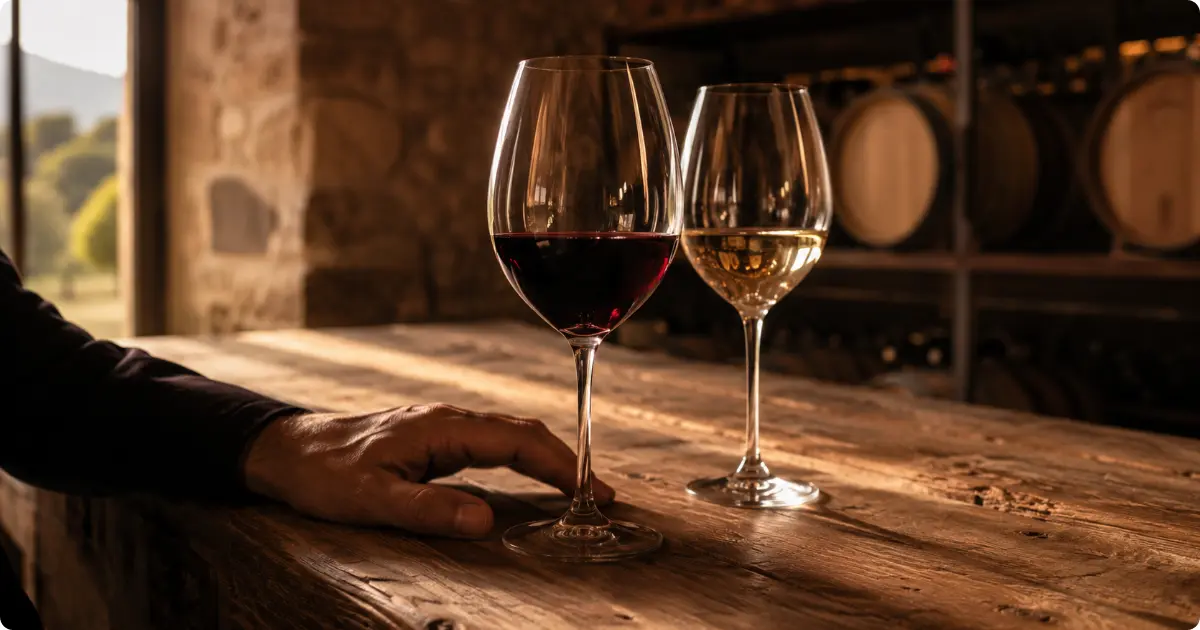
Nobody warns you about the perfume rule before your first winery visit. Nobody tells you to practice spitting at home, or that holding your glass by the bowl is the fastest way to signal you’ve never done this before. The unwritten codes of a tasting room are assumed not posted on any door.
That gap is exactly where first-timers lose confidence. You spend more time worrying about what to say, what to wear, and how not to embarrass your group than actually tasting the wine.
This guide closes that gap completely covering dress, behavior, tasting language, and the label rules that make every future visit easier.
The Short Version:
Wine tour etiquette means smart casual dress, no perfume, flat shoes, and holding your glass by the stem. Use the 5 S’s to taste and guide conversation. Book ahead, spit to pace yourself, and never monopolize the pourer. These rules hold across Napa, Sonoma, and Burgundy.
What to Wear to a Winery (Without Looking Like a Tourist)
| Winery Type | Dress Level | Wear This | Avoid This |
|---|---|---|---|
| Casual / Farm Winery | Smart casual | Dark jeans, clean shirt, comfortable boots or flats | White clothing, high heels, heavy fragrance |
| Mid-Range Tasting Room | Smart casual to business casual | Chinos or dark jeans, blouse or button-down, loafers | Flip-flops, leggings, strong cologne or perfume |
| Premium / Napa-Style Estate | Business casual | Sundress or blazer, neat trousers, polished flats or low boots | Sportswear, dangling sleeves, overly casual footwear |
| Vineyard Walk / Tour | Practical casual | Layers, grippy flat shoes or boots, crossbody bag, sunhat | Heels, sandals with no grip, white or light-colored clothing |
| European Winery (Burgundy, Bordeaux) | Smart casual minimum | Neat trousers, collared shirt or blouse, closed-toe shoes | Shorts, athletic wear, strong fragrance of any kind |
This section covers the unspoken dress code that applies to almost every winery in the world casual or high-end.
The Dress Code Nobody Posts on the Door
Most wineries have no formal dress code. That does not mean anything goes.
Smart casual is the universal standard across Wine Country. Think pressed jeans, a clean shirt, a light layer not a cocktail dress, not sweatpants.
- Choose dark colors — they hide the inevitable red wine splash
- Wear layers — barrel rooms and cellars run cold even in summer
- Pick flat shoes, loafers, sandals, or boots over heels
- Bring a crossbody bag — your hands will be full the entire visit
- Skip leggings and flip-flops — they signal you’re not taking it seriously
The terrain matters as much as the venue. Vineyard tours involve uneven soil, gravel paths, and wooden cellar stairs. Stilettos and soil are not a match.
The No-Perfume Rule That Most First-Timers Break
This is the single most violated rule in every tasting room — and the one that annoys hosts the most.
Wine tasting is almost entirely an olfactory experience. Your nose does the majority of the work before your palate takes a single sip. A strong scent from perfume, cologne, or scented body lotion overrides the wine’s aromatics for you and for everyone standing near you.
- Skip all perfume and cologne on tasting day — not just reduce it
- Avoid strongly scented deodorant, hairspray, and body lotion
- Choose unscented sunscreen if you’re doing a vineyard walk
- Don’t brush teeth right before — minty residue kills wine flavor
INSIDER SECRET: Eat something before you arrive. Not a mint a proper meal. An empty stomach accelerates the alcohol, and no amount of etiquette saves the person who’s swaying by the third pour.
What to Carry and What to Leave in the Car
Your hands are working tools at a wine tasting. They hold a glass, take notes, and gesture toward the barrel room. Plan accordingly.
- Use a small crossbody bag — not a clutch or handheld purse
- Bring a phone or small notebook for tasting notes
- Carry water — hydration between pours keeps your palate sharp
- Pack a light snack if touring multiple wineries back-to-back
- Leave large bags, strollers, and anything with wheels behind
Smart visitors come ready to move. You may shift from tasting bar to vineyard to cave without warning.
How to Act at a Winery Like You’ve Been There Before
This section covers the behavioral codes that signal respect for the winery, for other guests, and for the experience itself.
Book Ahead and Arrive on Time
Most wineries now operate by reservation only. Walk-ins work at some casual tasting rooms, but assuming availability on a summer Saturday is a gamble that usually loses.
- Reserve online or by phone — at least 48 hours ahead
- Confirm child and pet policies before you arrive
- Show up slightly early — late arrivals disrupt timed tastings
- Never arrive after a tour has started and expect to join mid-session
- If plans change, cancel the reservation no-shows cost small wineries real money
Showing up prepared signals to the host that you take the experience seriously. That often translates directly into more generous pours and better conversation.
Hold Your Glass the Right Way
It seems minor. Hosts notice immediately.
Always hold a wine glass by the stem, not the bowl. The reason is practical: body heat from your hand warms the wine, which changes its flavor profile — especially for whites and rosés that should be served cool.
- Grip the stem between thumb, index, and middle finger
- Keep the bowl completely free of fingerprints for clean visual assessment
- Set the glass down on the table when you’re not actively tasting
- Never fill your own glass if a host is present — let them pour
This one habit instantly communicates that you understand what wine tasting is actually about.
When to Spit (and Why the Pros Always Do)
Spitting is not rude. It is professional. Every sommelier, winemaker, and serious visitor does it because staying sharp across six to ten pours requires it.
Most tasting rooms provide a spit bucket on the bar or at each station. Use it without hesitation.
- Spit to pace yourself across multiple pours
- Practice at home first — get close to the bucket and spit gently
- Pour any unfinished wine into the bucket too — that’s what it’s for
- Don’t crowd the bucket — take your sip, step aside, then return
- Never spit into your glass or onto the floor
Traveling to multiple wineries in a single day without spitting is the fastest way to remember nothing and regret everything by 3 p.m.
What to Say at a Wine Tasting
This section gives you a usable tasting vocabulary and the exact questions that generate the best conversations with pourers and winemakers.
The 5 S’s Framework Your Tasting Script
Every trained taster uses the same five-step method. Once you know it, you always have something intelligent to say.
The 5 S’s stand for See, Swirl, Sniff, Sip, and Savor — a systematic sensory sequence that turns casual drinking into actual tasting.
- See: hold the glass against a white background and assess color depth and clarity
- Swirl: rotate the glass on the table for five to ten seconds to release aromatic compounds
- Sniff: push your nose fully into the glass and take short, sharp inhalations
- Sip: take a moderate sip and let it coat the entire palate — front, sides, and back
- Savor: notice the finish — how long flavors linger after you swallow
The finish is where wine quality reveals itself. Exceptional wines leave flavor on the palate for minutes. That length of experience is what separates a memorable bottle from a forgettable one.
Questions That Make You Sound Knowledgeable
You don’t need to know everything. You need to ask the right things.
Winemakers and pourers are at a tasting because they want to share what they’ve made. Curious questions are welcomed far more than silence or nodding.
- Ask: “What grape varieties went into this blend?”
- Ask: “How long did this spend in oak before bottling?”
- Ask: “What food would you pair this with?”
- Ask: “Is this typical of the vintage or unusual for the region?”
- Avoid: long monologues about wines you’ve tasted elsewhere
If the room is busy, keep questions short and step aside after your pour. If it’s quiet, go deeper — those conversations often lead to cellar access and wines not on the standard menu.
How to Describe Wine Without Sounding Pretentious
You don’t need to say “barnyard notes with a finish of wet pencil shavings” to sound like you know what you’re doing.
Honest, simple language works better than borrowed jargon in a tasting room.
- Say: “This is drier than I expected — is that typical of the appellation?”
- Say: “I’m getting something fruity on the nose but earthy on the finish.”
- Say: “I prefer the first pour — the acidity felt more balanced.”
- Avoid: pretending to identify 14 specific aromatics if you genuinely can’t
- Avoid: dismissing wines publicly as “not for me” — keep that opinion private
The goal is conversation, not performance.
The Biggest Winery Mistakes to Avoid
This section covers the errors that mark visitors as unprepared and how to sidestep every one of them.
Wearing the Wrong Shoes
This comes up in nearly every winery guide because it happens constantly. High heels, platform sandals, and slippery-soled shoes fail on vineyard rows, gravel paths, cellar stairs, and cave floors.
- Choose closed-toe shoes or grippy-soled sandals for any vineyard tour
- Wear boots if visiting during or after rain — vineyard soil turns to mud fast
- Avoid white shoes — dust and red wine end that story in the first hour
- Dress for terrain first, aesthetics second
One twisted ankle in a barrel room ruins the day for everyone in your group.
Getting Drunk Instead of Tasting
A winery is not a bar. The entire experience the host, the glasses, the pouring is built around appreciation, not volume.
- Limit visits to two to four wineries per day maximum
- Eat a full meal before starting and snack between wineries
- Drink water between every pour — not optional
- Designate a driver before the day starts, not after the fourth tasting
- Use the spit bucket — it exists for exactly this reason
Wineries notice when a group is there to get drunk rather than taste. Staff have every right to stop service.
Monopolizing the Pourer
Tasting rooms run on movement. Other guests are waiting. The pourer is managing multiple people at once.
- Take your glass and step back from the bar after each pour
- Allow others access to the host — don’t form a one-on-one blockade
- Keep conversations concise when the room is full
- Return when the space opens up if you want to ask more
- Never reach over other guests to refill your glass
Giving space is the most underrated sign of a seasoned wine tourist.
Wine Rules Every First-Timer Should Know
| Percentage | What It Allows on the Label | Example | Who Sets the Rule |
|---|---|---|---|
| 75% | Name a single grape variety | “Cabernet Sauvignon” or “Chardonnay” | TTB (federal US standard) |
| 85% | Name a specific AVA or vintage year | “Napa Valley” or a harvest year on the label | TTB + California/Oregon state law |
| 95% | Name a specific vineyard | “To Kalon Vineyard” or “Peters Vineyard” | TTB + state-level enforcement |
| 100% | Use the term “Estate Bottled” | Grapes grown, crushed, and bottled entirely on-site | TTB — strict definition |
This section explains the key wine rules that govern labels and serving knowledge that makes every future visit more rewarding.
The 75-85-95 Rule (It’s on Every Label)
This is the US wine labeling framework that defines what a bottle is actually allowed to say. Understanding it helps you read any label with confidence.
The rule works in three tiers. To list a grape variety on the label such as Cabernet Sauvignon or Chardonnay at least 75% of the wine must come from that grape. To name a specific region or AVA (American Viticultural Area), 85% of the grapes must come from that area. To name a specific vineyard on the label, 95% of the grapes must originate from that vineyard.
- 75%: grape variety can be named on the label
- 85%: a specific AVA or growing region can be named
- 95%: a specific vineyard can be named
- 100%: “Estate Bottled” — grapes grown, crushed, and bottled entirely on-site
California applies stricter standards than federal baseline Napa Valley wines must meet the 85% AVA rule to carry the Napa name on the label.
The 20-Minute and 30-Minute Temperature Rules
Temperature is one of the most common ways wine gets served wrong at home and occasionally at wineries too. These two rules fix that.
The 20-minute rule is a simple serving guideline: take white wine out of the fridge 20 minutes before pouring, and put red wine into the fridge for 20 minutes before serving. This moves each wine toward its ideal serving temperature without requiring a thermometer.
The 30-minute rule operates on the same logic with slightly more margin: chill reds for 30 minutes before serving to let fruit flavors come forward, and pull whites 30 minutes early to let suppressed aromas open up.
- Serve whites too cold: aromas disappear and acidity spikes
- Serve reds too warm: alcohol dominates, flavors go flat and heavy
- Target range for whites: 45–55°F (7–13°C)
- Target range for reds: 60–68°F (15–20°C)
At a winery, these decisions are made for you. But knowing the rules helps you understand why the host serves certain wines in certain glasses at certain points in the tasting.
Should You Buy a Bottle? Tipping Etiquette Explained
Two questions every first-timer quietly wonders about and rarely asks.
On buying: you are never obligated to purchase a bottle after a tasting. However, if you genuinely loved a wine especially a small-production or tasting-room exclusive buying is one of the most direct ways to support the winery. Many top bottles are only available on-site.
On tipping: there is no universal rule. In the US, tipping in tasting rooms is appreciated but not required a winery is not a restaurant. If a host spent significant time with your group, guided you through additional pours, or opened something special, a tip is a generous acknowledgment.
- Skip the guilt purchase if nothing genuinely moved you
- Buy the bottle if it’s an exclusive or limited production
- Tip when a host went above and beyond — $5 to $10 per person is reasonable
- Joining a wine club is the highest-value gesture for a winery you love
- Always ask what a wine club membership includes before signing up on-site
Bottom Line
Wine tour etiquette is not about memorizing rules. It is about showing up as a respectful, curious guest who makes the experience better for everyone in the room including yourself.
Our research consistently shows that the visitors who get the best experiences are not the ones who know the most about wine. They are the ones who arrive prepared, ask genuine questions, hold their glass by the stem, and give the host room to do their job. Dress smart, skip the perfume, use the spit bucket, and let the 5 S’s guide everything you say. Do those five things and you will never feel out of place in any tasting room in the world.
