


Saba has no beaches. No resorts. No cruise ship pier. For most Caribbean islands, that would be a death sentence. For Saba, it’s the entire point.
The travelers who find this five-square-mile volcanic island aren’t looking for swim-up bars. They’re looking for 20 hiking trails through cloud forest, 30 protected dive sites with virtually no crowds, and an island that still feels like a discovery. The problem is that planning a trip here is genuinely confusing ferry schedules conflict, cost estimates vary wildly, and most guides treat Saba as a day trip footnote from St Maarten.
This guide covers Saba as the full destination it deserves to be: every trail rated, every dive site explained, real costs broken down, and the logistics of actually getting there laid out clearly.
QUICK ANSWER:
Saba is a five-square-mile Dutch Caribbean island with no beaches, no resorts, and 20 hiking trails through cloud forest. Its protected marine park holds over 30 dive sites shared by roughly 30 divers daily. Reach it via a 12-minute flight or 90-minute ferry from St Maarten.
What Makes Saba Different from Every Other Caribbean Island
Saba isn’t competing with Aruba or St Maarten. It’s not trying to.
- Skip Saba if you want white sand beaches or nightlife
- Choose Saba for pristine diving, serious hiking, and total quiet
- Expect a volcanic peak rising 877 metres straight from the ocean
- Prepare for just 2,150 residents across four tiny villages
- Accept that only 124 rooms exist on the entire island
- Use US dollars everywhere — no currency exchange needed
The island is a special municipality of the Netherlands. However, English is the dominant language. Mount Scenery, the dormant volcano at Saba’s centre, is the highest point in the entire Kingdom of the Netherlands. That fact surprises most visitors. A country famous for being flat owns the Caribbean’s tallest peak.
Saba earned the nickname “The Unspoiled Queen” because the local government deliberately limits development. There are no mega-resorts, no casinos, and no cruise ship terminals. The Saba Conservation Foundation manages both the marine park and land trails with strict environmental protections. As a result, coral health and fish populations remain among the strongest in the Caribbean.
How to Get to Saba Island
Every trip to Saba starts in St Maarten. There’s no way around this. No direct flights connect Saba to the US, UK, or mainland Europe.
Flying from St Maarten
WinAir operates multiple daily flights from Princess Juliana International Airport. The flight takes 12 minutes. However, the landing is unforgettable.
- Book WinAir flights early — only 16-17 passengers per plane
- Expect Juancho E. Yrausquin Airport, the world’s shortest commercial runway at 400 metres
- Budget roughly $150–$210 round trip from St Maarten
- Allow buffer time — wind cancellations happen regularly
- Pay a $10 departure tax in cash when leaving Saba
- Note there are no ATMs at the airport
INSIDER SECRET: Sit on the left side of the plane flying in. The approach over Saba’s cliffs is one of the most dramatic landings in commercial aviation.
Ferry from St Maarten
Two ferry services connect the islands. Both depend heavily on sea conditions.
- The Edge departs Tuesdays and Fridays from Simpson Bay at 9 AM
- Makana Ferry runs multiple days weekly from Bobby’s Marina in Philipsburg
- Crossing takes approximately 90 minutes each way
- Round-trip fares start around $57 for same-day return
- Rough seas cancel crossings without much notice — especially in winter
- Motion sickness is common on the open channel
The Edge works well for day trips. It arrives at 10:30 AM and departs Saba at 3:30 PM. Makana offers more scheduling flexibility for multi-day stays. Additionally, Makana connects to St Eustatius and St Kitts.
For travelers connecting through St Maarten, our guide to the best things to do in St Maarten & St Martin covers both sides of that island.
Best Time to Visit Saba
| Factor | Dec–Apr (High Season) | May–Jul (Shoulder) | Aug–Nov (Low Season) |
|---|---|---|---|
| Weather | Warm, driest months | Warm, occasional showers | Hot, humid, rain likely |
| Temperature | 26°C–29°C (79°F–84°F) | 27°C–30°C (81°F–86°F) | 27°C–31°C (81°F–88°F) |
| Water Temp | 25°C–27°C (77°F–80°F) | 27°C–28°C (80°F–82°F) | 28°C–29°C (82°F–85°F) |
| Hurricane Risk | None | Very low | Moderate to high |
| Accommodation Prices | Peak rates | 10–25% lower | Up to 50% lower |
| Crowds | Busiest (still quiet) | Few visitors | Very few visitors |
| Whale Sightings (Diving) | Jan–Apr: humpbacks | Unlikely | Unlikely |
Saba’s weather stays relatively consistent year-round. However, two seasons create different experiences.
- Visit December to April for the driest, sunniest conditions
- Expect daytime temperatures between 26°C and 31°C year-round
- Avoid August to October when hurricane risk peaks
- Book May to November for lower prices and fewer visitors
- Pack a light layer — evenings get surprisingly cool at elevation
- Prepare for rain at the summit regardless of season
February, March, and April are the driest months overall. Meanwhile, Mount Scenery’s summit stays misty most days. That cloud forest exists precisely because moisture is constant at 877 metres. Therefore, hiking the peak on a clear day requires luck and early starts.
Water temperatures range from 25°C in winter to 29°C in summer. Diving visibility typically exceeds 18 metres and can reach well beyond 30 metres on calm days.
Hiking Saba: 20 Trails from Cloud Forest to Coastline
Saba has 20 maintained hiking trails. That’s remarkable for an island measuring just five square miles. The terrain shifts dramatically with elevation — coastal scrubland to rainforest to cloud forest within a single hike.
- Pay a $3 trail fee at the Trail Shop in Windwardside
- Pick up trail maps from the Saba Conservation Foundation
- Wear shoes with strong grip — volcanic steps get dangerously slick
- Start summit hikes early before clouds build
- Carry water on exposed coastal trails — shade disappears quickly
- Check trail advisories — some routes require guides after erosion damage
Mount Scenery — The Kingdom’s Highest Point
This is Saba’s signature hike. A staircase of 1,064 steps climbs from Windwardside through rainforest to the summit.
The trail passes through distinct ecological zones as it ascends. Giant elephant ears and tree ferns dominate the lower sections. Higher up, mountain palms and heliconias appear. Near the summit, the elfin cloud forest takes over — mountain mahogany trees draped in hanging moss and orchids.
The hike takes roughly 90 minutes one way and is rated strenuous. Despite being Saba’s most popular trail, you’re unlikely to encounter crowds. The summit plaque marks the highest point in the Kingdom of the Netherlands. On clear days, views stretch to neighbouring islands. Most days, however, clouds wrap the peak.
The Ladder — 800 Steps of History
Until 1970, all cargo arriving by ship was carried up these 800 hand-carved stone steps from Ladder Bay to The Bottom. The trail cuts through dry forest with mahogany and cinnamon trees.
This hike is steep and exposed. However, the historical weight makes it powerful. For centuries, everything Saba needed — food, building materials, medicine — came up these steps on human backs.
Sandy Cruz and the Elfin Forest
The Sandy Cruz trail approaches Mount Scenery from the northeast through Hell’s Gate. It connects with the Elfin Forest Trail near the summit.
- Expect extremely muddy conditions in the cloud forest sections
- Bring hiking poles — the trail is slippery year-round
- Allow 2-3 hours one way depending on route combination
- Watch for rare orchids and mountain fuchsia above 600 metres
The Elfin Forest itself is a rare tropical montane cloud forest. These ecosystems contain a disproportionately high number of endemic and threatened species worldwide.
Spring Bay Heritage Trail
This moderate trail runs from English Quarter to Kelbey’s Ridge near the airport. It passes through dry forest, old stone walls, and former plantation land.
The terrain is mostly open and exposed. Goats wander the scrubland. Cacti and small flowers line the path. At Spring Bay, ruins of an 18th-century sugar boiling house remain visible. The Saba Archaeological Foundation asks that any artefacts found be reported but not disturbed.
Diving and Snorkeling Saba’s Marine Park
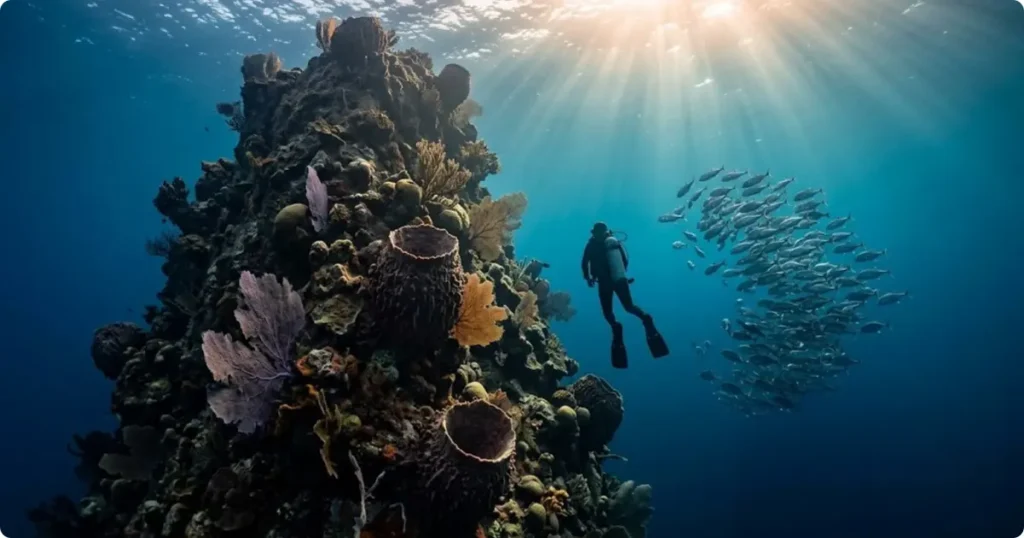
The Saba National Marine Park encircles the entire island from the high-water mark to 60 metres deep. Established in 1987, it was one of the first marine parks in the Caribbean. Today, it remains one of the few that is completely self-sustaining financially.
- Access over 30 permanently moored dive sites
- Dive only with licensed operators — Sea Saba and Saba Divers are the main shops
- Pay a $3 per-dive marine park fee
- Expect visibility from 18 metres to virtually unlimited
- Encounter sharks, turtles, groupers, rays, and seasonal humpback whales
- Note that all fishing within the park is restricted
Because fishing is heavily regulated, marine life density is exceptional. Ecological surveys have recorded over 150 fish species with healthy populations. Nassau groupers, which are endangered elsewhere in the Caribbean, appear on nearly every dive here.
Best Dive Sites on Saba
Saba’s volcanic origins created underwater formations found nowhere else in the region.
The pinnacles are the headline attraction. These coral-encrusted volcanic towers rise from the ocean floor to within 26 metres of the surface. Third Encounter and its neighbouring Eye of the Needle are considered bucket-list dives. Schools of horse-eye jacks, nurse sharks, and large groupers patrol these structures. Between January and April, humpback whales are often audible underwater.
Tent Reef sits just west of Fort Bay harbour. Starting at only four metres deep, it’s accessible to newer divers. The site is popular for night dives, with frequent octopus sightings.
Man O’ War Shoals features twin rocky peaks connected at the base. The entire structure is covered in yellow sponges and attracts barracuda, black-tip reef sharks, and stingrays.
Currently, only three dive boats operate daily on the reef. That means a maximum of roughly 30 divers share the marine park on any given day. For comparison, popular Caribbean dive destinations see hundreds daily.
Snorkeling Without a Boat
Shore snorkeling options are limited because of Saba’s rocky coastline. However, two accessible spots exist.
Wells Bay offers shallow water with juvenile fish species. A small beach appears and disappears depending on swell conditions. Torrens Point, at the northern end of Wells Bay, provides clear visibility with depths from 1.5 to 9 metres.
Sea Saba runs boat snorkeling trips to Wells Bay, Torrens Point, Cove Bay, and Ladder Bay. These are the best way to experience Saba’s underwater world without a dive certification.
Saba’s Four Villages: Where to Stay and Eat
One road connects everything on Saba. Locals call it “The Road.” It runs from the airport through all four villages to Fort Bay harbour. The road itself is an engineering marvel — hairpin turns carved into volcanic cliffs.
Windwardside
This is Saba’s tourism hub. Most accommodation, restaurants, and shops cluster here at around 490 metres elevation.
- Stay at Queen’s Hotel or the Saba Arawak Hotel for central convenience
- Book El Momo Cottages for budget-friendly hillside accommodation
- Eat at Tropics Café for Caribbean staples with valley views
- Reserve Brigadoon for an elevated dinner — candlelit and intimate
- Visit the Trail Shop for maps, guides, and handmade Saban crafts
- Check opening hours in advance — not everything runs daily
Windwardside is also where you’ll find the Harry L. Johnson Museum and most of the island’s bars. Nightlife is quiet. Expect friendly conversations with locals rather than clubs.
The Bottom
Saba’s capital sits in a valley below Mount Scenery. Government buildings, the hospital, and the medical school are based here. The Bottom has fewer dining options than Windwardside. However, it offers easy access to The Ladder trail and the road down to Fort Bay.
Hell’s Gate and St Johns
Hell’s Gate (also called Zion’s Hill) sits above the airport. A scattering of houses cling to Mount Scenery’s slopes. St Johns is a quiet residential village with Saba’s primary school.
Both villages offer starting points for hiking trails. Neither has significant tourist infrastructure. That’s part of their appeal.
How Much Does Saba Cost? Real Budget Breakdown
| Expense | Budget | Mid-Range | Comfort |
|---|---|---|---|
| Accommodation (per night) | $80–$120 | $130–$200 | $210–$300+ |
| Meals (per day) | $25–$40 | $45–$75 | $80–$120 |
| Diving (2-tank dive) | — | $100–$130 | $130–$160 |
| Hiking | $3 trail fee | $3 trail fee | $50–$80 (guided) |
| Transport (taxi/day) | $8–$15 | $15–$30 | $55+ (car rental) |
| Daily Total (per person) | $115–$180 | $190–$280 | $300–$450+ |
Saba isn’t cheap. Everything arrives by boat or plane, and that pushes prices up. However, it’s not outrageous either.
- Budget $150–$300 per day depending on activity level
- Expect accommodation from $80/night (guesthouses) to $250+ (boutique hotels)
- Pay $15–$35 per meal at most restaurants
- Budget $100–$150 per dive with equipment rental
- Factor in $150–$210 for round-trip flights from St Maarten
- Carry cash — some restaurants and taxis don’t accept cards
A realistic four-night trip for two costs roughly $2,000–$3,500 including flights from St Maarten, accommodation, meals, and a few dives. Budget travelers who self-cater in cottages with kitchens can reduce costs significantly. Meanwhile, there’s simply less to spend money on. No shopping malls, no tourist traps, no overpriced beach clubs.
Saba uses the US dollar as official currency. ATMs exist but aren’t always reliable. Bring backup cash. Visa and Mastercard are accepted at larger restaurants and hotels.
For broader Caribbean budget planning, our Caribbean holiday cost guide covers prices across the region.
What About Beaches?
This is Saba’s most important expectation to set. There are essentially no beaches.
- Wells Bay has a small strip of sand that appears and disappears with swell
- Cove Bay offers rocky shoreline access for swimming
- Neither compares to traditional Caribbean beach experiences
- Come to Saba for what’s above and below the waterline — not at it
If beaches are non-negotiable, Saba is the wrong island. Nearby Bonaire offers excellent diving with actual beaches. That’s the trade-off.
Practical Tips for Visiting Saba
First-time visitors benefit from knowing these details before arrival.
- Pack hiking shoes with aggressive grip — smooth soles are dangerous here
- Bring a light rain jacket — mountain weather shifts fast
- Use reef-safe sunscreen if snorkeling or diving
- Rent a car only if comfortable with extreme mountain roads
- Consider taxis instead — drivers know every hairpin turn
- Tip 10-15% at restaurants where service charge isn’t included
- Respect village dress codes — swimwear isn’t appropriate inland
- Expect 110V US-style electrical outlets
- Budget one extra day as weather buffer for ferry or flight cancellations
Saba is one of the safest islands in the Caribbean. Crime is virtually non-existent. Solo travelers report feeling completely comfortable on trails and in villages.
Hitchhiking remains common and accepted. On an island where everyone knows each other, it’s simply how people get around.
The Verdict
We’ve researched dozens of Caribbean islands across this silo. Saba stands apart from all of them. It’s not for everyone and that’s precisely the point. There are no beaches to lounge on, no resorts to retreat to, and no nightlife to speak of. What Saba offers instead is increasingly rare: a Caribbean island that hasn’t been smoothed down for mass tourism.
The diving rivals anywhere in the region. The hiking is the best in the Caribbean, full stop. The community of 2,150 people is genuinely welcoming in a way that larger islands simply can’t replicate. Our research consistently shows that travelers who commit to Saba three nights minimum, open to adventure come back calling it their favourite island.
Saba asks more of its visitors. It rewards every bit of that effort.
